


——————————————————————————————————————————————————
Editor's Note
At the invitation of Chinese Premier Li Qiang, Bangladeshi Prime Minister Tarique Rahman conducted an official visit to China from June 24 to 26, 2026. Ahead of this diplomatic event, Liu Zongyi, a prominent scholar of South Asian studies, offered incisive insights into the trajectory of China-Bangladesh relations. He pointed out that despite decades of steady diplomatic relations and fruitful pragmatic cooperation, bilateral ties still face restraints from structural trade imbalances, external geopolitical interference and bilateral perceptual gaps. Meanwhile, he emphasized that built upon sovereign equality and mutual benefit, China-Bangladesh relations are well-grounded and harbor vast untapped potential for Belt and Road-based South-South cooperation.
The substantial outcomes of Prime Minister Rahman’s China visit have fully verified Liu Zongyi’s prescient judgments. The two sides upgraded bilateral ties to a new-era community with a shared future and secured major progress in tariff support, infrastructure building, livelihood cooperation and multilateral coordination through multiple pragmatic agreements. These concrete results ease chronic bilateral development pressures, boost reciprocal partnership, and testify to the accuracy of Liu’s judgments on bilateral relational essence and strengths. We therefore recommend Liu's insightful analysis for readers' reference.
——————————————————————————————————————————————————
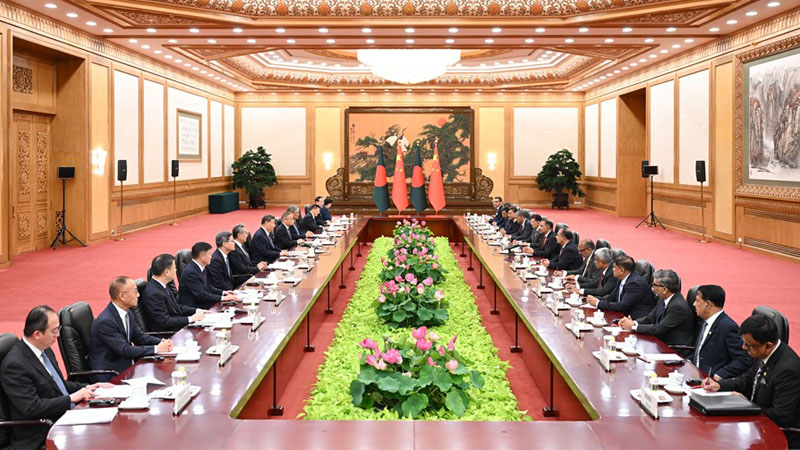
President Xi Jinping met with Tariq Rahman, Prime Minister of Bangladesh, who was in China for an official visit, at the Great Hall of the People in Beijing.
(Source: Xinhua News Agency, photographed by Li Xiang)
Prime Minister of the People's Republic of Bangladesh Tarique Rahman will pay an official visit to China from June 24th to 26th. This will be Rahman's first overseas visit since taking office, with China being the second stop. Bangladeshi media have high expectations for this visit, predicting that more than 15 bilateral instruments will be signed, covering major infrastructure and industrial projects.
China and Bangladesh are traditional friends and neighbors and comprehensive strategic cooperative partners. Over the more than 50 years since the establishment of diplomatic relations, the two countries have developed their ties based on the Five Principles of Peaceful Coexistence, treating each other with mutual respect and equality, and setting an example of cooperation among developing countries.
At the bilateral political level, the two countries maintain frequent high-level exchanges. In 2024, their relationship was upgraded to a comprehensive strategic cooperative partnership. Economically, China has been Bangladesh's largest trading partner for 15 consecutive years and has granted zero-tariff treatment to 100 percent of taxable items for Bangladeshi products exported to China. In infrastructure, landmark projects such as the Padma Bridge have significantly improved Bangladesh's transportation network.
At the regional level, China and Bangladesh jointly safeguard peace and stability and work to address the Rohingya issue. Their cooperation under the Belt and Road Initiative has helped build regional connectivity networks. Together with other South Asian countries, they have also established platforms promoting poverty reduction and regional governance.
Despite these remarkable achievements, the China-Bangladesh relationship still faces several challenges in advancing to a higher level. The first challenge is interference from geopolitical competition. Some major powers attempt to draw Bangladesh into exclusive security and development frameworks, even interfering in its domestic affairs, pressuring it to sign unequal agreements, and using narratives such as "debt traps" to discredit China-Bangladesh cooperation projects.
The second challenge relates to issues of domestic political stability and policy continuity in Bangladesh. The third challenge arises from differences in perception. On the one hand, public understanding of China in South Asia remains limited, and some Bangladeshi elites are deeply influenced by Western development models, often adopting Western economic theories and governance practices while remaining cautious about China's development path and production-capacity cooperation. On the other hand, although some Bangladeshi elites recognize the advantages of China's model and the benefits of cooperation, they worry about provoking the US and other Western countries. Additionally, some domestic narratives attribute the trade deficit solely to an "influx of Chinese goods," overlooking structural factors such as Bangladesh's limited export diversity and capacity.
These challenges are not insurmountable but require greater wisdom and patience from both sides. In particular, more candid dialogue and exchanges are needed to bridge perception gaps. At the same time, Bangladeshi policymakers need the political courage to truly prioritize "Bangladesh First." Prime Minister Rahman's visit will demonstrate to both nations and the international community the extent of Bangladesh's commitment to cooperation with China.
Based on the key areas highlighted by Bangladeshi media for this visit, the two sides are moving toward closer economic and strategic alignment.
First, industrial cooperation will be strengthened. China has consistently encouraged its enterprises to establish manufacturing bases in Bangladesh, leveraging its labor-cost advantages to produce high-value-added goods for export.
Second, cooperation within the Global South and at the regional level will be enhanced, facilitating Bangladesh's integration into Asian industrial chains and multilateral mechanisms. Platforms such as the China-South Asia Expo and the China-Pakistan-Bangladesh trilateral cooperation mechanism can serve as bridges connecting Bangladesh with other regional economies.
Finally, the two sides will strengthen exchanges on governance to help Bangladesh explore a development path suited to its national conditions. Institutionalized exchanges among political parties, think tanks and local governments can be enhanced. There is no one-size-fits-all model for development, and Bangladesh has both the conditions and the capability to pursue a modernization path that integrates both Eastern and Western experiences.
The author is the director of the Center for South Asia Studies, Shanghai Institutes for International Studies.
Source: Rahman’s visit will boost closer China-Bangladesh alignment, published on June 23, 2026 | Global Times
The views do not necessarily reflect those of CIIDS.