


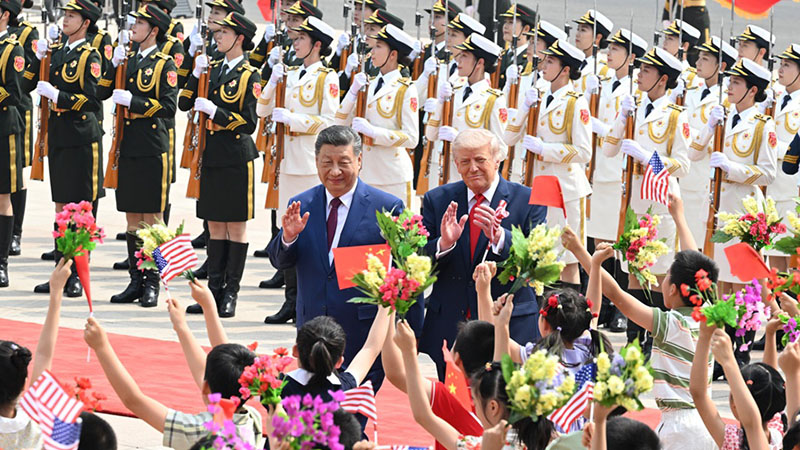
Chinese President Xi Jinping holds a welcome ceremony for U.S. President Donald Trump, who is on a state visit to China, outside the Great Hall of the People prior to their talks in Beijing, capital of China, May 14, 2026. Xi held talks with Trump at the Great Hall of the People in Beijing on Thursday. (Xinhua/Rao Aimin)
——————————————————————————————————————————————————
Editor's Note
On May 14–15, 2026, U.S. President Donald Trump paid his second state visit to China after a nine-year interval, receiving a high-level ceremonial welcome in Beijing. In their summit, President Xi Jinping and President Trump reached a landmark consensus to frame China–U.S. relations as a "constructive relationship of strategic stability"—a new vision that provides strategic guidance for bilateral ties over the next three years and beyond. Defined by cooperation as the cornerstone, healthy competition, manageable differences, and an enduring commitment to peace, this paradigm marks a pivotal turn for the world's most important bilateral relationship and injects much-needed certainty into an increasingly volatile global order.
For this special coverage, we present an insightful commentary by Professor Zhao Minghao of the Center for American Studies at Fudan University, who offers a nuanced analysis of the visit's implications and the future trajectory of Sino–U.S. ties. His perspective represents a prominent strand of thinking within the Chinese academic community and is published here to enrich readers' understanding of this historic moment. The stabilization of China–U.S. relations not only serves the fundamental interests of both nations but also stands as a major positive factor for global peace, development, and multilateral cooperation.
——————————————————————————————————————————————————
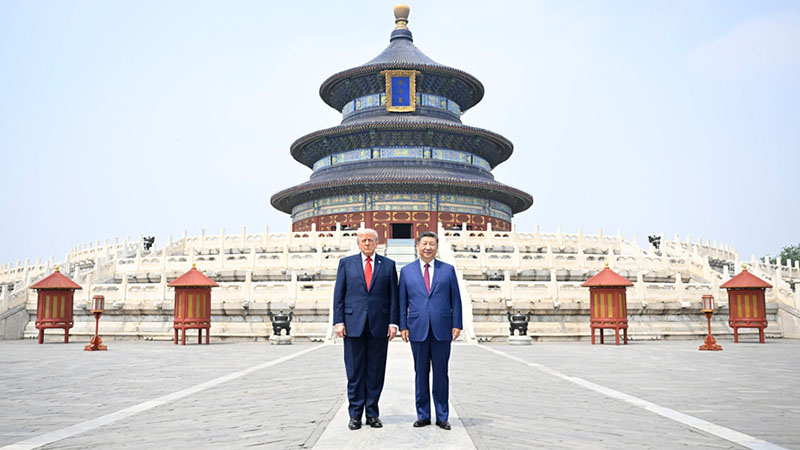
Chinese President Xi Jinping and U.S. President Donald Trump have a photo taken in front of the Hall of Prayer for Good Harvests while visiting the Temple of Heaven in Beijing, capital of China, May 14, 2026. (Xinhua/Shen Hong)
The summit between the leaders of the world's two largest economies on Thursday is widely expected to inject stability into the turbulent world, as both sides agreed to build a constructive relationship of strategic stability.
The new vision is designed to provide strategic guidance for bilateral relations over the next three years and beyond. The "constructive strategic stability" is interpreted to be a positive stability with cooperation as the mainstay, a sound stability with moderate competition, a constant stability with manageable differences, and an enduring stability with promises of peace.
No wonder the meeting between President Xi Jinping and his US counterpart Donald Trump will open a new chapter in Sino-US ties. The goal to make 2026 a historic and landmark year for US-China relations is crucial, as historically, landmark years have typically included events like former US president Richard Nixon's visit to China in 1972 and the establishment of Sino-US diplomatic ties in 1979.
The questions about whether the two countries can overcome the Thucydides Trap and create a new paradigm of major-country relations need both countries to answer. Since the beginning of the US leader's second term in office, China-US relations have transitioned from intense tensions — after Washington launched a tariff war — to gradual stabilization. Both sides need to grasp the precious opportunity presented by the summit to preserve this hard-won stability. US policymakers have come to realize that China is not as vulnerable as they had once assumed, and that even extreme pressure would not force Beijing to yield.
Despite the repercussions of the tariff war, China remains firmly established as the world's second-largest economy, with its domestic growth and exports showing remarkable resilience. In 2025, China reported a trade surplus of nearly $1.2 trillion, a 20 percent increase year-on-year. In the first quarter of 2026, China's GDP grew by 5.0 percent year-on-year, calculated at constant prices.
Recent developments prove that Beijing's tactics of "fighting for talks" and "struggling for stability" in its dealings with Washington have been effective. Some senior US officials have abandoned their previous arrogance and recognized that China is a strong player; making exorbitant demands and bluffing won't work.
In areas such as rare earths, China has continued to strengthen its national economic security system and advance legislation on counter sanctions and anti-long-arm jurisdiction, thereby enhancing its tool kit for responding to US pressure.
According to an analysis by Bloomberg Economics, approximately 4 percent of US GDP, or about $1.2 trillion, is generated in industries that use rare earths, and most of these industries lack effective alternatives to Chinese suppliers.
The Economist has pointed out that more than a year after the US administration initiated the tariff war, countries around the world are seeking new markets and forging new trade deals, gradually shifting the center of gravity in global trade away from the US.
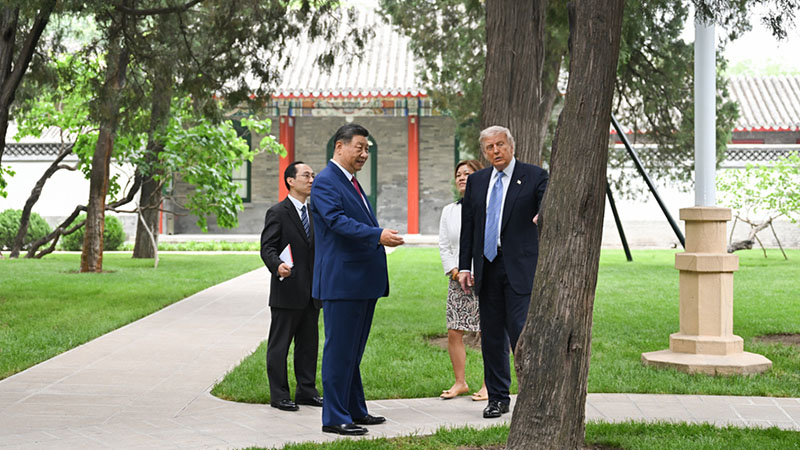
Chinese President Xi Jinping welcomes U.S. President Donald Trump upon Trump's arrival at Zhongnanhai in Beijing, capital of China, May 15, 2026. Xi and Trump had a private meeting on Friday in Beijing. (Xinhua/Li Xiang)
In contrast, China has remained committed to an open world economy and worked to promote universally beneficial and inclusive globalization. Starting May 1, China removed tariffs on 53 African countries with which it has diplomatic relations, becoming the first major economy to grant unilateral zero-tariff treatment to Africa. This move reflects Beijing's willingness to pursue shared development with Global South countries. China has remained the largest trading partner of the Association of Southeast Asian Nations since 2009, with bilateral trade exceeding 7.55 trillion yuan ($1.11 trillion) in 2025. Notably, a trilateral cooperation mechanism among ASEAN, China and the Gulf Cooperation Council has been established, leveraging the strengths of all parties to create synergy for win-win development.
Clearly, in a contest defined by openness and certainty, China has gained the upper hand. Over the past few years, China has notably strengthened its ability to steer Sino-US relations, consistently adhering to the approach of "if forced to fight, China will fight to the end, and for talks, the door is open". The White House's new National Security Strategy describes China as a "near-peer" and proposes building a "genuinely mutually advantageous economic relationship with Beijing".
Importantly, US public opinion on China is also showing positive signs. A Pew Research Center poll released in mid-April found that around 27 percent of people in the US hold a favorable view of China, a 6 percentage-point increase from 2025 and double the lowest point recorded in 2023. Many US residents are skeptical about the effectiveness of confrontational policies such as tariffs and express concern about blow back on the US economy.
Additionally, survey data from Chatham House, an independent London-based policy institute, show that more than half of respondents support their government purchasing China's clean technology products. Within the US strategic community, there is a growing chorus supporting a pragmatic and flexible approach to Sino-US relations. Lyle Goldstein, director of the Asia Program at Defense Priorities, a think tank, has argued that the current international context presents an opportunity to stabilize Sino-US ties. He has even suggested the need for a new political document to establish a model of peaceful coexistence between the two countries — a "fourth joint communiqué".
Deep-seated differences between Beijing and Washington undeniably persist in areas such as the economy, trade, military affairs, and technology. The Taiwan question — at the core of China's core interests — is the most important issue in Sino-US relations. If it is handled properly, the bilateral relationship will enjoy overall stability. Otherwise, the two countries will have clashes and even conflicts, putting the entire relationship in great jeopardy, Xi said, urging the US side to exercise extra caution in handling the Taiwan question.
In this context, the Xi-Trump summit not only provides an important opportunity for both sides to explore more constructive ways of engagement, fostering conditions for increased face-to-face communication between the two heads of state, but may also prove to be historic if the new vision of Sino-US ties can be heeded and acted on. This is important for the two countries, the world and humanity.
Source: New vision for stable, constructive ties,By Zhao Minghao | CHINA DAILY
The views do not necessarily reflect those of CIIDS.